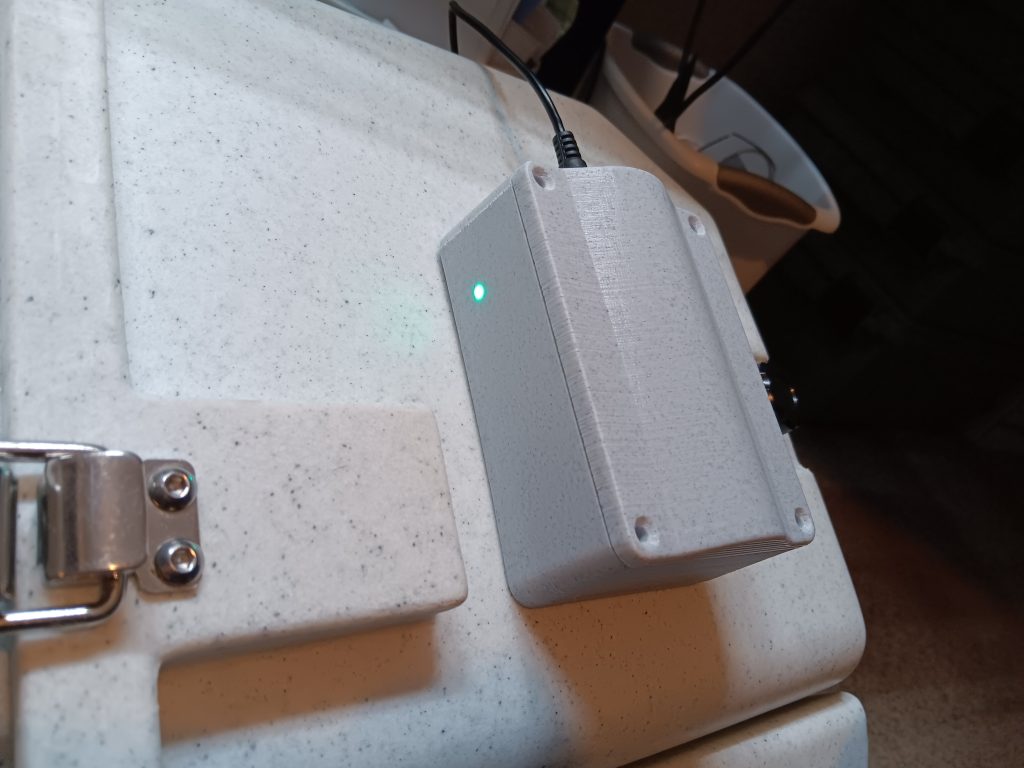
For this project, I worked to create an automatic turner to replace a manual spindle turner on the Natures Head composting toilet.
The automatic turner reduces the space needed for installing and operating the composting toilet, eases use and operation, and it allows for the compost to be turned over on a regular schedule without requiring user intervention.
Why It Matters
With a rise in Van Life, Sailing, and off-grid or nontraditional lifestyles, safely disposing or handling of human waste is becoming increasingly important.
Composting toilets do not require any water, chemicals, or one-time-use plastic, and are typically considered as the most environmentally friendly option.
Composting toilets also allow far greater use before requiring emptying. A couple can typically use a composting toilet full-time for 3-4 weeks before emptying the solids becomes necessary which far exceeds holding tank capacity on most RV’s or Sailboats.
How Do Composting Toilets Work?
Composting toilets work by separating liquids and solids to prevent the creation of sewage. By themselves, each form of waste is far easier to manage.
The liquids can simply be dumped down a toilet or on the soil in many areas.
Solids are mixed with coconut coir and dried out using a lower power fan. Periodically turning the material evenly distributes the moisture so that drying can be more effective.
Although the waste can start composting, it should be further composted before using as soil.
The Challenges
One of the bigger challenges I faced for this project, was mechanical. A lot of force is required to turn the shaft. I settled on using a motor and worm gear to minimize the distance the turner protrudes from the side of the toilet. Space is limited in many Van’s and Sailboats, including our own.
Coupling the worm wheel to the toilet’s agitator shaft isn’t easy, set screws aren’t enough to hold it. I had to bore out the hole in the wheel to make it larger enough to fit the shaft, create a special key device, and drill and tap two holes in the wheel for installing the special key.
Experimenting With Molds and Casting
3d printing PLA is not strong enough for creating the special key, so I experimented with creating silicone molds and casting with thickened epoxy.
The process worked extremely well and I was impressed by how much detail was transferred with the mold. Unfortunately the layer lines were also transferred, so I’d like to try repeating the process with a resin printer. I’d also like to try experimenting with a pressure pot and vacuum chamber to eliminate any air bubbles.
Thickened epoxy was much stronger than 3d printed PLA. I think it’s workable, but I would like to further improve the key’s strength. Casting the key with RTV resin was nowhere near strong enough.
The Circuit Board
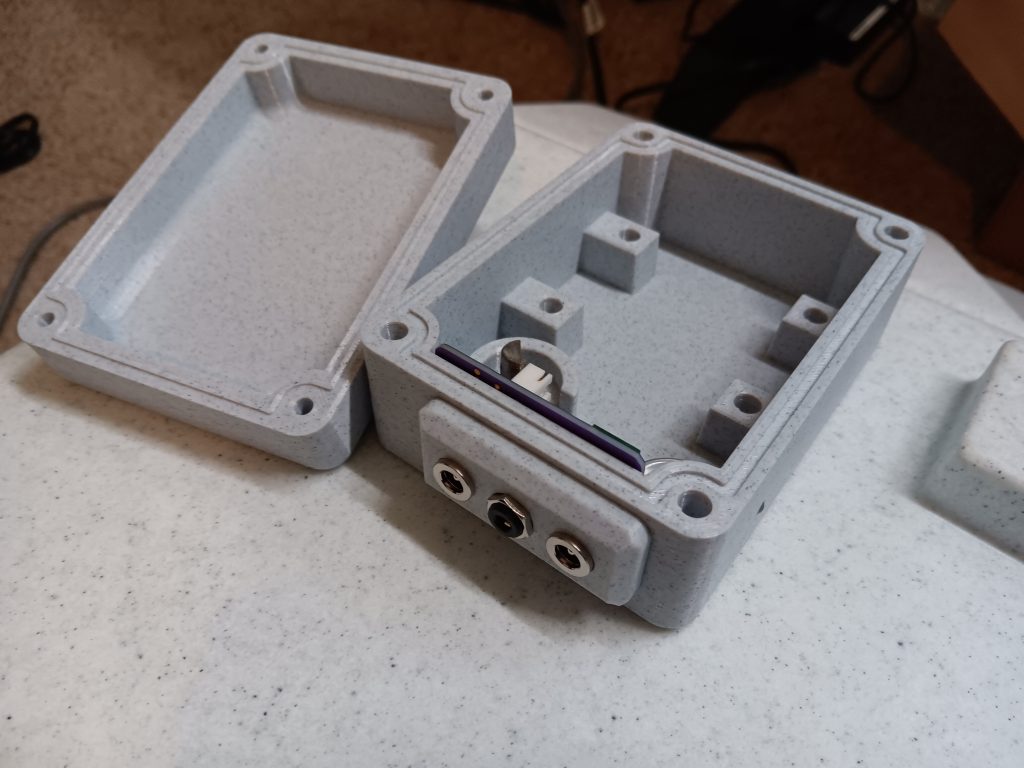
The circuit board takes 12v from the factory power supply that’s meant to power the fan. It then has an output port for powering the fan that can be turned on or off to save power or prevent an over-discharge of an off-grid system’s battery. It also has a port for use with an external switch to trigger rotation, or for an external i2c temperature and humidity sensor.
The motor is driven an H-bridge. Motor current is measured with a shunt resistor to monitor the torque required to turn the compost and notify the user when the solids need to be emptied. Monitoring the motor current can also help prevent applying too much torque and breaking the mechanical assembly. A hall effect sensor measures the rotation of the shaft to ensure it’s spinning and to return the shaft to it’s desired position.
An LED interfaces with a light pipe that can signal to the user.
The board is controlled by a nRF52805 base module for it’s low cost and to leave the option open for BLE. In the future a operated BLE switch could simplify system installs or a phone app could simplify configuration.
What Still Needs To Be Done
Unfortunately some higher priority projects on our sailboat surfaced and I had to put the project on pause. It still needs firmware.
I’d also like to try casting the entire enclosure in place of 3d printing to eliminate layer lines for sanitary reasons. It was designed with no overhangs and drafts on all the surfaces to make casting easier.